
Hope to Ride, Ride to Hope
Isolated communities in Vietnam receive lifeline and hope from the most unexpected of motorbike convoys
When the Daughters of Our Lady of the Holy Rosary in the Diocese of Long Xuyen found Mr. Minh, he was curled up on the damp ground. His stove had not been lit for two days.
"I thought I would die alone in the corner of this hut without anyone knowing," Mr. Minh recalled.
The 82-year-old man lived alone in a dilapidated house in An Giang province in southwest Vietnam. Severe rheumatism made walking difficult. He survived on wild vegetables he could gather and occasional meals from neighbors.
"The sisters came, gave me warm bowls of rice, and made a clean bed for me. Now, I am no longer afraid of rainy and windy nights alone," he said.
Sisters of the Daughters of Our Lady of the Holy Rosary bring food supplies to an elderly resident at his home in a rural community in Vietnam. Photo by FMSR.
Sisters of the Daughters of Our Lady of the Holy Rosary bring food supplies to an elderly resident at his home in a rural community in Vietnam. Photo by FMSR.
The congregation now provides him with rice every month. The sisters take turns visiting him each week. With regular meals and medication, his health has stabilized. Their visits have also eased the isolation that once surrounded him.
Mr. Minh is among the people the congregation has accompanied during 15 years of ministry in remote communities in rural Vietnam.
The Daughters of Our Lady of the Holy Rosary work in six remote villages and parish stations in a semi-mountainous area.
The congregation supports about 160 poor and near-poor households, 80 elderly people living alone without relatives to care for them, and around 130 children, including orphans, school dropouts, and children suffering from malnutrition.
Nearly two-thirds of the households surveyed by the congregation live in deteriorating bamboo huts, makeshift thatched shelters, or severely degraded charity houses.
The sisters have encountered severe food shortages, particularly before the harvest season. They have also seen chronic alcoholism among adults linked to domestic violence and child neglect, persistent illiteracy, and children leaving school early to work.
Elderly people living alone and severely malnourished children are among those the congregation considers most vulnerable.
“Food, leaking roofs, and access to clean water remain immediate concerns,” one sister said.
The sisters have responded with a mix of emergency aid, education, healthcare, and small livelihood projects. Much of the work, however, begins with repeated visits to the same households.
A ministry of presence
One of the religious sisters of the Daughters of Our Lady of the Holy Rosary, who requested anonymity for safety reasons, told LiCAS News that four sisters take turns living among the villages and conduct regular pastoral visits each week.
“We attend to medical emergencies and other urgent cases as they arise,” she said, adding that they travel into isolated areas and work with village chiefs and trusted community leaders to “understand the circumstances of individual families” rather than relying only on administrative records.
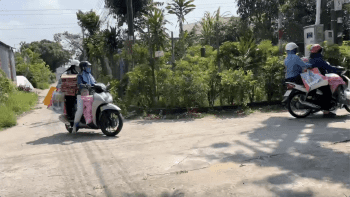
Reaching them is not always easy. The sisters travel five to 10 kilometers on old motorbikes along narrow and rugged mountain paths. In the early years, they also had to overcome shyness, hesitation, and skepticism among Indigenous residents.
"There are times when walking through the muddy trails under heavy rain makes our legs give out, and we feel completely exhausted," one sister involved in the ministry said.
"But thinking of an elderly person waiting for a hot bowl of soup, or a child waiting for a box of milk, gives us the strength to forget all fatigue. Our mission is to bring love to the most abandoned places," she added.
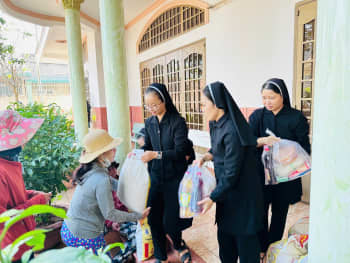
Families receive rice, instant noodles, cooking oil, and basic condiments during emergencies. The congregation also helps pay basic medical expenses for people suffering from critical illnesses.
Children attend free evening literacy classes. The sisters also teach personal hygiene and disease prevention and provide milk and nutritional support to malnourished children.
Some families have received chickens and ducks for breeding. The sisters also help residents establish home gardens to supplement household food supplies and income.
For one widow, the support meant that her children could remain with her.
Keeping a family together
Ms. K. was 34 when she was left to raise three young children after her husband died from a serious illness.
They lived in a leaking thatched hut. She took whatever casual work she could find, but her income was unstable. Her eldest child left school to care for the younger children. At times, the family survived on thin porridge with salt.
The sisters provided a scholarship that allowed the eldest child to return to school. They also gave monthly milk and nutritional assistance to the youngest child, who had been severely malnourished.
The congregation said the eldest child now attends school regularly and can read and write fluently. The youngest has gained weight, is healthy, and has become active.
"If the sisters hadn't extended their helping hands, out of sheer starvation, I might have had to send my children to an orphanage or give them up for adoption," Ms. K. said.
"Seeing my oldest child back in school, I can only cry out of pure joy and gratitude," she added.
Signs of change
Families enrolled in the congregation's sponsorship program have seen improvements in food security.
According to the sisters, households receiving regular support no longer experience the severe seasonal hunger that once forced some families to survive on wild forest leaves instead of rice during the pre-harvest lean season.
Over the past three years, the congregation has also mobilized resources to repair 12 leaking roofs and replace deteriorating bamboo walls with more durable wooden structures. Three more houses are being built or repaired.
The sisters maintain a basic medical cabinet and provide guidance on hygiene and disease prevention. The congregation reported that diarrhea, dengue fever and wound infections have become better controlled in the villages.
More than 60 children under 5 who regularly received milk and nutritional porridge have overcome stunting and malnutrition, according to the congregation's assessment.
The sisters also report fewer children wandering the villages or dropping out of school. More now attend the congregation's evening classes voluntarily.
Public sanitation and environmental awareness have also improved, according to the congregation. Daytime public intoxication has declined, which the sisters attribute to years of counseling.
A sister of the Daughters of Our Lady of the Holy Rosary tends to an elderly woman during a home visit, part of the congregation’s regular accompaniment of vulnerable residents in rural Vietnam. Photo by FMSR
A sister of the Daughters of Our Lady of the Holy Rosary tends to an elderly woman during a home visit, part of the congregation’s regular accompaniment of vulnerable residents in rural Vietnam. Photo by FMSR
Residents often describe the changes less in numbers than in what the sisters' visits have meant to their families.
"The sisters are not my biological relatives, yet they care for me more than my own family. Every time they visit, this leaking house is filled with laughter again,” one elderly beneficiary said.
One parent spoke of the literacy classes in terms of opportunities that had not been available to an earlier generation.
"The greatest gift the sisters give to our children is literacy. My life was full of hardship because I was illiterate. Thanks to the sisters, my children's lives will have a much brighter future,” the parent said.
A resident said the sisters' presence had also affected life in the wider community.
"The sisters here are extraordinary. They never shy away from hardships, no matter how heavy or grueling the work is. Since they arrived, the villagers live in much greater harmony, and the young ones no longer loiter around causing trouble,” the resident said.
The congregation said the work is rooted in the sisters' religious vocation, adding that they see "the image of the Divine in the poorest of the poor" and find "a true spiritual joy that money can never buy" in serving them.
The gains, however, remain fragile.
Sisters of the Daughters of Our Lady of the Holy Rosary prepare bags of food and other supplies for distribution to vulnerable families in rural communities in Vietnam. Photo by FMSR.
Sisters of the Daughters of Our Lady of the Holy Rosary prepare bags of food and other supplies for distribution to vulnerable families in rural communities in Vietnam. Photo by FMSR.
Sisters of the Daughters of Our Lady of the Holy Rosary deliver food and other supplies to residents of a rural community in Vietnam, where the congregation has accompanied vulnerable families for 15 years. Photo by FMSR.
Sisters of the Daughters of Our Lady of the Holy Rosary deliver food and other supplies to residents of a rural community in Vietnam, where the congregation has accompanied vulnerable families for 15 years. Photo by FMSR.
Sisters of the Daughters of Our Lady of the Holy Rosary distribute food supplies to elderly women as part of the congregation’s outreach to vulnerable communities in rural Vietnam. Photo by FMSR.
Sisters of the Daughters of Our Lady of the Holy Rosary distribute food supplies to elderly women as part of the congregation’s outreach to vulnerable communities in rural Vietnam. Photo by FMSR.
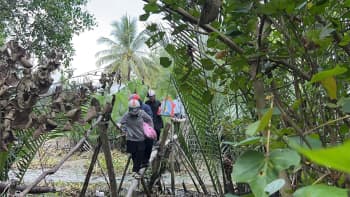
Sisters of the Daughters of Our Lady of the Holy Rosary carry food and other supplies across a narrow wooden footbridge during a visit to a rural community in Vietnam. Photo by FMSR.
Sisters of the Daughters of Our Lady of the Holy Rosary carry food and other supplies across a narrow wooden footbridge during a visit to a rural community in Vietnam. Photo by FMSR.
Sisters of the Daughters of Our Lady of the Holy Rosary help one another cross a narrow wooden footbridge while carrying supplies to families in hard-to-reach rural communities in Vietnam. Photo by FMSR.
Sisters of the Daughters of Our Lady of the Holy Rosary help one another cross a narrow wooden footbridge while carrying supplies to families in hard-to-reach rural communities in Vietnam. Photo by FMSR.
A sister of the Daughters of Our Lady of the Holy Rosary cares for an elderly woman during a home visit in rural Vietnam, where the congregation regularly accompanies older people living without family support. Photo by FMSR.
A sister of the Daughters of Our Lady of the Holy Rosary cares for an elderly woman during a home visit in rural Vietnam, where the congregation regularly accompanies older people living without family support. Photo by FMSR.
Sisters of the Daughters of Our Lady of the Holy Rosary deliver rice and food supplies to a man at his home during one of their regular visits to vulnerable families in rural Vietnam. Photo by FMSR.
Sisters of the Daughters of Our Lady of the Holy Rosary deliver rice and food supplies to a man at his home during one of their regular visits to vulnerable families in rural Vietnam. Photo by FMSR.
What remains
Only four sisters are responsible for hundreds of beneficiaries.
The congregation said the number of households needing help is greater than what it can support. Limited personnel and unstable funding have restricted how far the ministry can expand.
“The sisters would like to maintain a daily presence in every village or establish a permanent center where healthcare and education could be provided continuously,” one sister said.
Several needs remain unresolved. Plans to drill wells and establish a clean water filtration system have stalled because of insufficient funding.
Eighteen houses still have severely leaking and structurally unsafe roofs that risk collapsing during the storm season.
At least 35 households do not have standard toilets. Open defecation continues in some areas and contaminates local water sources.
Travel becomes harder during the rainy season. Dirt roads turn into thick mud and can no longer be used by motorbikes. The sisters then continue on foot, carrying relief supplies on their backs along slippery paths where rockslides are another risk.
The congregation estimates that 350 million to 400 million Vietnamese dong (US$11,000 to US$15,000) is needed each year to sustain and expand the work. The amount would cover food assistance, scholarships, minor housing repairs, and basic medicine.
“We are also trying to reduce long-term dependence on emergency aid,” a sister said.
Beyond emergency relief
Over the next three to five years, the congregation hopes to move toward sustainable community development, with greater emphasis on children's education and livelihood opportunities for poor women.
If resources become available, repairing the 18 unsafe roofs before the rainy and storm season is the immediate priority.
Its longer-term goals are broader. The sisters want families to become self-sufficient in food, children to attend mainstream schools at the appropriate age, and communities to organize their own mutual-aid activities without depending on outside charity.
"The poor in remote areas are not lazy; they simply lack an opportunity and a foothold to stand up," the congregation said in a message to benefactors.
"Your small act of sharing today is not just a meal—it is an entire future changed for a child, a life transformed,” they added.
(Names have been changed or withheld to protect the identities of those interviewed for security reasons.)
With generous support from
Pontifical Society of the Propagation of the Faith
SIGNIS Wisdom Calls Project
Edited by Peter Rachada Monthienvienchai
Produced by June Nattha Nuchsuwan
Published August 26, 2026
© Copyright MMXXVI LiCAS.news
 Built with Shorthand